
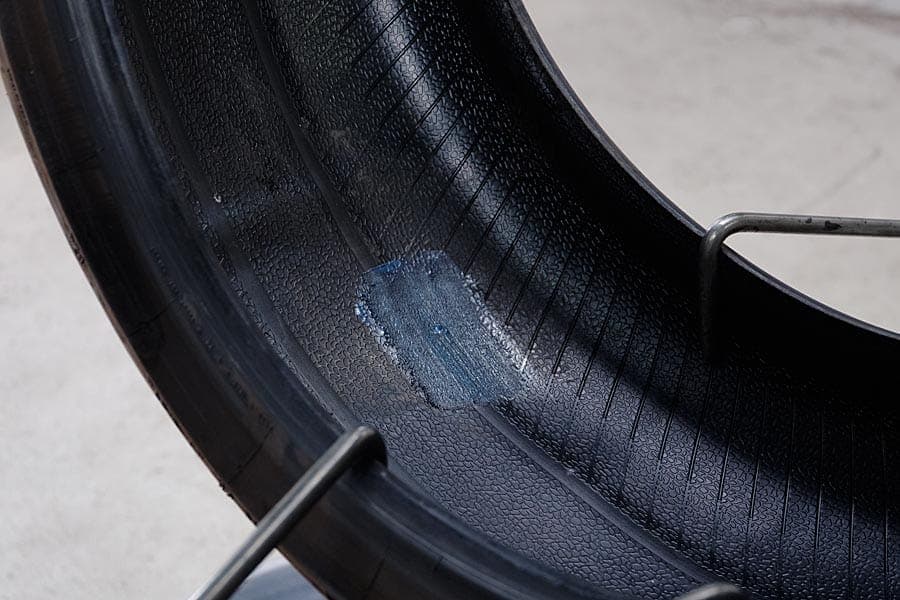
Puncture?
We fix it.
Permanent inside repair with a vulcanised combination plug. As strong as the tyre was before. Book a time for inspection and repair.
Puncture
What you should know.
If you get a puncture, drive as little as possible and come in to us as soon as possible. Driving with low tyre pressure risks damaging the carcass and the tyre. At that point the tyre can no longer be repaired and will need to be replaced. If the model and condition can't be matched, that could mean 2 or 4 new tyres depending on your car model.
Swap to the spare wheel or have the car towed to us. A repair kit with foam can sometimes work, but it usually damages the inside of the tyre and can lead to the tyre having to be replaced regardless of how the damage looked to begin with.
If the hole is in the tread area it can usually be repaired. Exceptions include holes that went in at a very steep angle, holes caused by a large object, or holes caused by a metal or glass fragment where the damage is a gash rather than a clean puncture. We remove the tyre, inspect it from the inside, and if it can be repaired we carry out a permanent inside repair with a vulcanised combination plug. It becomes just as strong as the tyre was before. The tyre is then fitted back, balanced, and the wheel is put back on the car.
A plug or spray from the outside is a temporary fix, not a repair. The tyre is never removed, so nobody knows what the damage looks like on the inside. Use it to get to the workshop, not as a permanent solution.
Can we repair a run-flat tyre?
No, we recommend replacement. The run-flat carcass can be damaged after just a few hundred metres on a flat tyre, and by the time the car reaches us there is no way to tell how long it has been driven without air. To be safe, we replace it instead.
Price list.
Permanent inside repair
Wheel swap for 1 tyre (standard car)
Wheel swap for 1 tyre (SUV / larger car)
Puncture spray clean-out
The repair is permanent. The wheel swap is needed if we are to help get the wheel back on the car after repair. If you bring in a loose wheel you only pay for the repair.
Prices incl. VAT.
Puncture repairs at all our workshops
Choose a workshop
Choose the workshop that suits you best. Come in for inspection and repair.
Showing 7 of 7 workshops
- Book a time
Bromma
Ulvsundavägen 154, 168 67 Bromma - Book a time
Brunna
Energivägen 13, 196 37 Kungsängen - Book a time
Sollentuna
Bisslingevägen 4 / Överby företagspark, 192 77 Sollentuna - Book a time
Solna
Gårdsvägen 4, 169 70 Solna - Book a time
Täby
Enhagsvägen 11, 187 40 Täby - Book a time
Vasastan
Surbrunnsgatan 50, 113 48 Stockholm - Book a time
Tyresö
Energivägen 3, 135 49 Tyresö
Frequently asked questions.
Can't find the answer to your question? Our customer support knows almost everything about tyres and their handling. Email your question: [email protected]
What should I do immediately after a puncture?
Find a safe place to stop. Flat ground, ideally out of the way of other traffic. Switch on your hazard lights and put out a warning triangle if the car is parked where it is hard to see. Don't drive any more than absolutely necessary on a flat tyre. It's when the tyre folds under the car that the carcass takes the hit, and a damaged carcass can never be repaired. If you have a spare: swap it and come to us. If you only have a foam repair kit in the boot: inflate the tyre enough to limp here. It's not a real repair, just a lift to the workshop.
How do I swap to the spare wheel?
Make sure the car is stationary: handbrake on, preferably on flat ground. Loosen the wheel bolts a quarter turn before you start lifting. It's much easier while the tyre is still on the ground. Position the jack at the car's jacking point (the owner's manual shows where it is) and lift until the wheel clears the ground. Unscrew the bolts completely and lift off the damaged wheel. Fit the spare. Tighten the bolts alternately on opposite sides so the wheel seats straight. Lower the car and tighten the bolts firmly one last time. Drive straight to a workshop. A temporary spare (the narrow "space-saver") usually has a speed limit of 80 km/h and is not designed for long distances. If you feel unsafe or unsure, call roadside assistance instead. It's not a competition.
Which punctures can be repaired?
The hole needs to be in the tread area, the part of the tyre that contacts the road. If the hole is not too large we can almost always repair it. If the puncture is on the sidewall, on the shoulder (where the tread meets the sidewall) or down by the rim edge, it cannot be repaired. The rubber there bears too much load for a repair to hold. We always remove the tyre first and inspect it from the inside so we don't miss anything.
How long does the repair take?
30–45 minutes is usually enough once we get started. That gives us time to remove the tyre, inspect the inside, vulcanise in the plug, balance the wheel and refit it on the car. Book a time to skip the wait. Drop-in usually works too, but during peak season it can take a while.
How long does a repair last?
Permanently. A properly carried out inside repair should last until the tread is worn, meaning the rest of the tyre's life. It works at all speeds, including on the motorway. You can drive as if the puncture never happened.
Do I have to replace both tyres on the same axle?
Not always. We check the tread depth on the other tyre at the same time. If it is the same or close, repairing one is enough. If there is a big difference, or if both tyres are worn out anyway, we recommend replacing both so the car handles evenly and brakes equally on left and right.
Plug, patch or combination plug: what is the difference?
Plug from the outside: a pin is pushed through the hole without removing the tyre. Quick on the roadside, but nobody knows what it looks like on the inside. Counts as a temporary fix, not a repair. Patch on the inside: a rubber patch is glued over the hole from the inside. It seals, but only covers the hole in the rubber. Over time moisture can work its way in and start attacking the steel cord in the tyre. Combination plug from the inside (what we do): we remove the tyre, inspect it and insert a vulcanising plug that seals both the hole and the inside. Once the rubber has cured, the plug is part of the tyre. Permanent. And just as strong as before.